
Murakami’s Basement
A search for meaning in the magical realist prose of Haruki Murakami.

Perhaps one of the most useful images a person can have for understanding the often-confusing fiction of Haruki Murakami is that of a house. Specifically, it is a house with two basements. In 2002, not long after the publication of Kafka on the Shore, Murakami explained:
I think of human experience as being like a two-story house. On the first floor, people gather together to take their meals, watch television, and talk. The second floor contains private chambers, bedrooms where people go to read books, listen to music by themselves, and so on. Then there is a basement; this is a special place, and there are a number of things stored here. We don’t use this room much in our daily life, but sometimes we come in, vaguely hang around the place. Then, my thought is that underneath that basement room is yet another basement room. This one has a very special door, very difficult to figure out, and normally you can’t get in there—some people never get in at all… You go in, wander about in the darkness, and experience things there you wouldn’t see in the normal parts of the house. You connect with your past there, because you have entered into your own soul. But then you come back. If you stay over there for a long time you can never get back to reality.
My sense is that a novelist is someone who can consciously do that sort of thing.[i]
If you are familiar with Murakami’s work but have not read this quote before, this quote might have just sparked a moment of sudden realisation. It is arguably the key to understanding his famously confusing novels, filled with seemingly unexplainable events and a disorienting blend of realism and fantasy.
If you know Murakami well, then you have possibly heard him talk about this before as he sometimes describes his writing process as going down into a basement that he clearly views as a trip into the unconscious mind. It also connects rather obviously with certain occurrences in his novel (such as characters going down into wells or other subterranean spaces).
The above quotation is translated from Japanese by Murakami expert Matthew Carl Strecher and appears in his excellent book, The Forbidden Worlds of Haruki Murakami. He explains Murakami’s theory and provides this diagram:
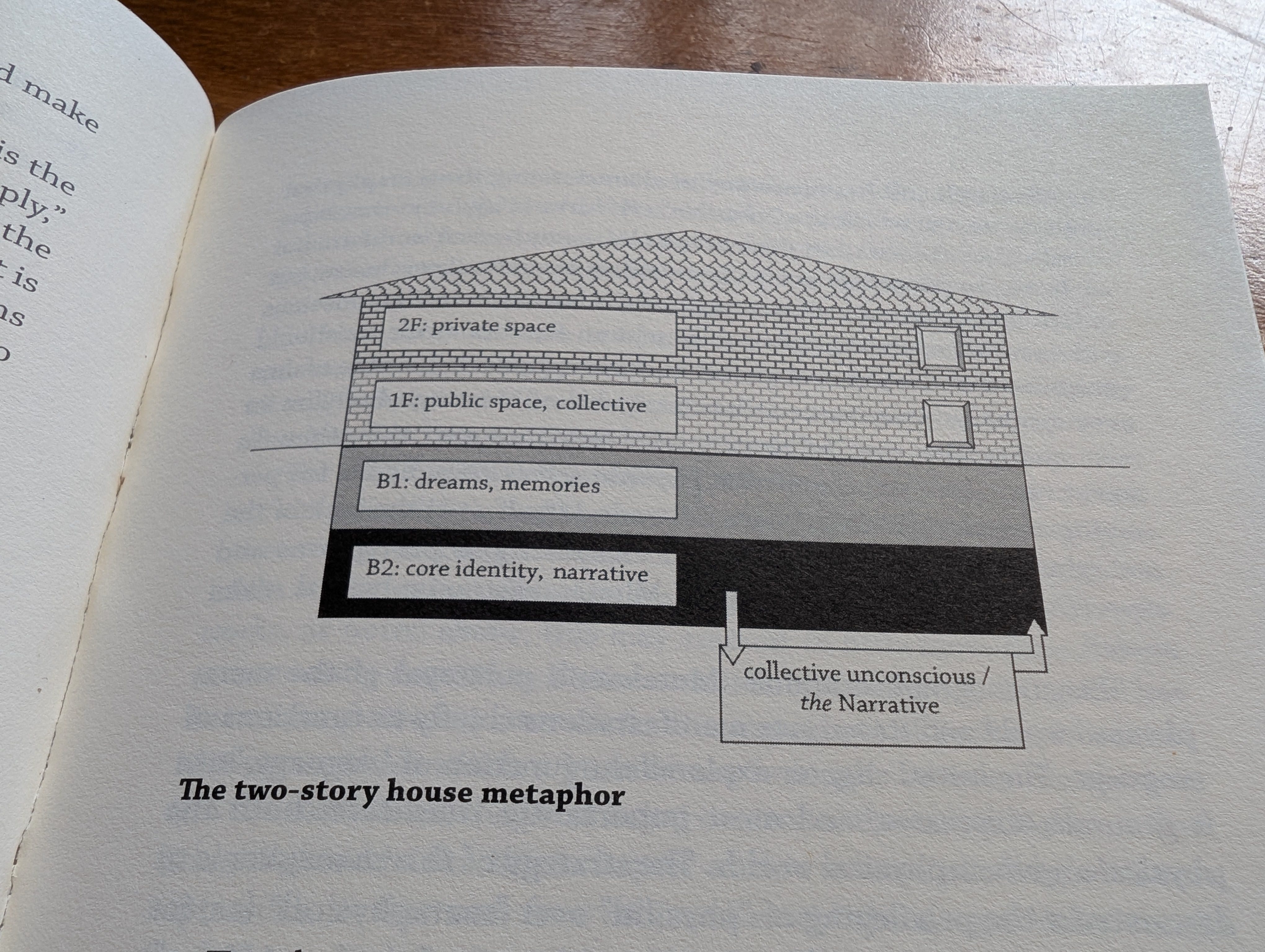
It is notable that Murakami says little of the first basement, so let’s turn to Strecher for more:
The first level of the basement is a shallow level of the metaphysical realm and is accessible both awake (as memory) and asleep (as dream). This is where we store memories, let our (conscious) imaginations wander, and in the most general sense of the word, “think.”[ii]
Strecher explains that “in the Murakami fictional world,” the second basement is a metaphysical realm that characters visit, which accounts for the strange occurrences in these books. He explains that in Murakami’s novels, “metaphysical” refers to:
that which actually appears to have a tangible element but exists inside some realm that does not. In this case I refer to the inner mind, which for Murakami’s characters is more than simply vague mental images, as it is in our nonfiction world, but which contains apparently tangible things as well. It is in this realm that Boku[1] can drink metaphysical beer with his dead friend Rat, can play a metaphysical game of pinball on his dead girlfriend Naoko, where Okada Toru can beat his metaphysical brother-in-law to death with a metaphysical baseball bat, and Tamura Kafka can rape his would-be sister. These things really happen, and yet they happen in a virtual world that happens to feel quite as physical, as tangible, as our own waking, conscious world.[iii]
Jonathan Dil notes in Haruki Murakami and the Search for Self-Therapy: Stories from the Second Basement that Murakami’s stories are not mere stories in the typical sense but monogatari, which Murakami called “basically what is in the deepest part of a person’s soul… It’s because it’s there in the soul’s depths that people can become linked together at the root.”[iv] This, he says, “resonates deeply with Jungian thought.” In fact, it more than resonates; it seems that Murakami has more or less taken his house image from Jung, who similarly talked of consciousness as a two-storey house in which there was a cellar and, beneath that, a cave that could be accessed by a secret doorway. Here, there were “scattered bones and broken pottery, like remains of a primitive culture.”[v]
This of course suggests that the second basement is not only the hidden part of one individual’s mind but perhaps a place linked to a wider collective unconscious, which we can see from the diagram in Strecher’s book, which I included above. Strecher took the liberty of saying the second basement had a “water supply” and a “drainage system” that linked the individual to the collective unconscious via the second basement.
I argued in my own book, Murakamian Magical Realism and Psychological Trauma, that it was partially this that makes Murakami’s books so universally popular. On the surface, they should not be nearly as relatable as they are. After all, they are typically about a lonely Japanese male in an urban environment who has lost something and experiences vaguely paranormal occurrences. Why should this speak to so many millions of fans around the world? But it is possibly his ability to tap into a second basement—which is linked somehow to a collective unconscious—that makes him more universally accessible than other writers. His books seem weird and sometimes perverse to readers, yet perhaps he has tapped into something that transcends culture. By going beyond the public and the private, and even beyond the first basement of memories and dreams, he has hit something that resonates with readers who have nothing in common with the author or narrator—perhaps even stories linked to our very nature as human beings, which have connected us across nations and races and over countless millennia.
As always, Murakami is reluctant to go into much detail on his influences and connections to other writers. Dil asked him directly about Jung and he replied:
I think the most important thing for my writing is to be unconscious. Once I get conscious about what I’m doing, I’m going to think, what’s the meaning of this? I don’t want to do that. I just want to write a good story. So that is my only interest. I don’t want to read [Jung’s] work because it could be dangerous for me as a writer.[vi]
Yet clearly he has read Jung and he admits as much in other interviews. His wife is also an avid reader of Jung.
All of this should help the reader to better understand Murakami’s novels… or perhaps to accept them rather than search for purely logical meaning. As the author told Mieko Kawakami, “A monogatari is a monogatari because you cannot interpret it… I think it is because the author does not know what is going on that meaning is free to grow within each individual reader.”[vii]
To learn more about this, see the three books mentioned above. Also, there’s more information about other books on Murakami’s work here:

Foonotes
[1] “Boku” is a first-person pronoun in Japanese, referring to a male speaker. Murakami often had unnamed male narrators in the first half of his career, so people writing about these books—for the sake of convenience—tend to refer to them by the name “Boku.”
Endnotes
[i] Translation by Matthew Carl Strecher, The Forbidden Worlds of Haruki Murakami, p.21
[ii] The Forbidden Worlds of Haruki Murakami, p.21
[iii] The Forbidden Worlds of Haruki Murakami, p.22
[iv] Jonathan Dil, Haruki Murakami and the Search for Self-Therapy: Stories from the Second Basement, ebook (no page number)
[v] Qtd in Haruki Murakami and the Search for Self-Therapy
[vi] Haruki Murakami and the Search for Self-Therapy
[vii] Translation by Jonathan Dil, Haruki Murakami and the Search for Self-Therapy