
Harry Styles Interviews Haruki Murakami
The pop star travels to Japan to interview the famous author.

I must say I was quite surprised to wake up this morning and see that a new Haruki Murakami interview had appeared online—and not just a few short quotes but a relatively lengthy discussion on a range of topics. This was even more surprising given that the interviewer was the pop star Harry Styles.
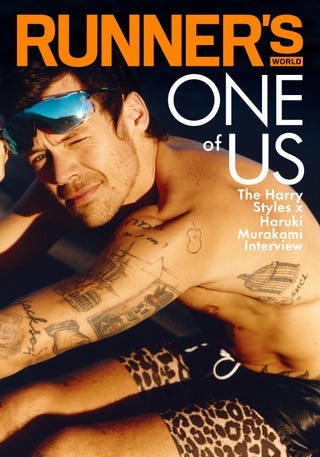
I can’t say I really know who Styles is but I’ve heard his name many times over the years and I gather he is a very popular musician. Apparently, he’s also a big fan of Murakami and travelled to Japan to meet him and has him some questions. This was for Runner’s World and the connection is that both the writer and musician are keen runners. Murakami has completed 25 marathons and Styles has recently done his first two.
The interview begins with Styles asking for advice. It’s a general question and as Murakami remarks it is not an easy one. Typically, he responds with a strange answer:
One of the important things for human beings is to embrace the contradiction. When I’m writing, I always feel I have a contradiction and that’s why I want to express myself…to understand it. Even at my age I’m still wondering, what is this chaos in me? That would be my advice to you as an artist as well as a man. If there’s something that’s dirty within you, you can’t just present it as is. You kind of have to turn the contradiction into something positive by sharing it with other people who might not think they have one. Sublimate those contradictions within you into art.
It is an interesting response but then perhaps it is not so surprising. If we look back over Murakami’s novels, we can see he often writes books whose meanings are unclear and contradictory. As I wrote in my book about him, he writes not to lecture people or make a clear moral statement but rather to ask questions and to understand things. (Later in this same interview, he admits that: “I’m just offering the question, not the answers.”)
They talk about finding balance between health and artistry. Murakami mentions musicians dying young because of their lifestyles but then says:
What I wanted to do was live a normal life because I’m just a normal guy—but then write abnormal books. That’s the kind of ideal that I was pursuing.
Just like his protagonists, he repeats “I’m just a normal/ordinary guy” a few times.
Styles asks him questions—fairly traditional, formulaic ones but based on a clear respect for Murakami and his work—but Murakami is predictably evasive. This is something he usually does with interviewers. Rather than directly answer questions or offer long, considerate answers full of opinions and anecdotes, he seems mostly to pull from stock phrases and little biographical details that we already know—he likes music, he owned a jazz bar, he never expected to be a writer, etc.
Styles asks him about sex and masculinity and Murakami completely avoids the question, which is a shame because it was not asked inappropriately. It was a reasonable question and it would’ve been good to hear Murakami’s honest thoughts. A journalist may perhaps have pushed to get a proper response, but the musician moves on to the next question.
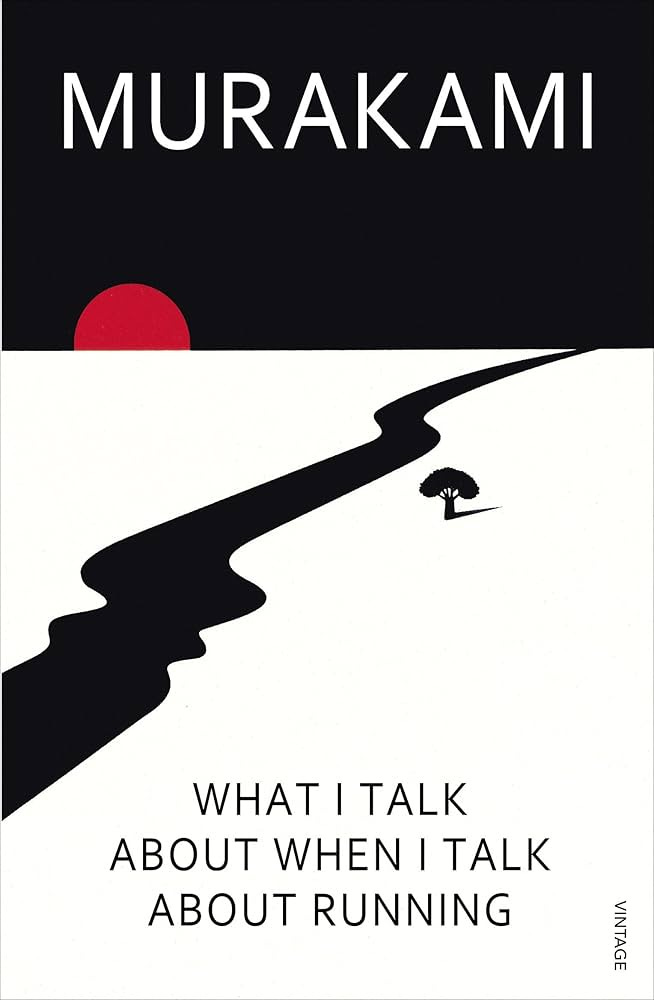
For the questions related specifically to running (and that accounts for most of them), the answers will be familiar to those who’ve read What I Talk About When I Talk About Running, Murakami largely repeats the same ideas, just as his other answers repeat the few bits of information and opinions that he’s previously been willing to put out into the world. For example:
When I come back to sit in front of the desk I begin thinking, but when I’m running, I’m kind of empty. Something comes into me, but I don’t notice it. To be empty is my one of my purposes with running. I feel that training your body is the way to create the perfect vessel, building a foundation for the ideas to come into.
One of the interesting quotes that emerges is not even a response to a question. After Styles says he respects Murakami’s privacy and unwillingness to share, Murakami begins talking about creativity:
I’ve been wondering, always, what is creativity? I have been writing books, creating something, for 45 years or so, but still I don’t know what creativity is. There is something in me, but I cannot grasp that essence at will. Because, uh, it just comes to me. And when I finish writing, it’s gone. And I wait until it comes again. But waiting is not an easy thing. Sometimes it’s so hard, because you are not sure if it’s coming back. But you have to wait.
He also goes on to say, “I’m still writing, and my new novel will be published this year. This July. I just finished it. I’m very happy!” I wrote recently about his few guarded comments on that next novel and what we can infer about it.
Finally, I loved this last statement from Murakami. He compliments Styles and then talks about how popularity and awards are unimportant:
You win an award because somebody else says you’re worthy of an award, but what’s more important is what you think is of value to your life.
Another bit of wisdom from a great and humble man.
I was duly impressed by Harry styles music when he was on Saturday night live around 4 years ago. It was right after the release of the album with watermelon sugar on it. He did a song from that album but a jazzy version has a really great vibe.
Whenever any one of my boomer generation brings up that there isn't any great music being made now I point to this video as far as Pop albums go I love pop music and he provided a great album this track is a real departure from the pop aspect of his songwriting.
https://youtu.be/OzkkchcSBkA?si=SK60_vRxFOllZ7OT
That is wild